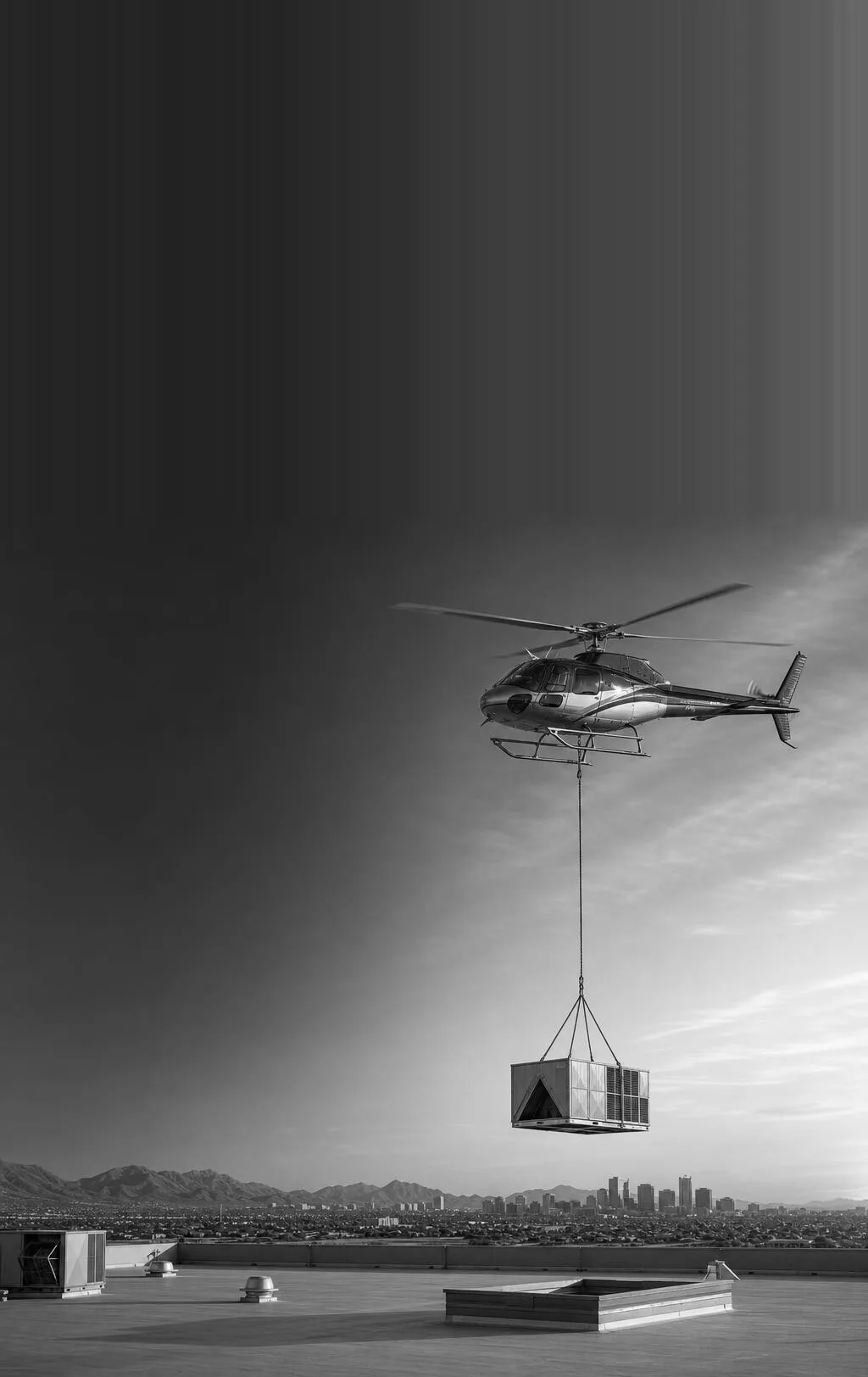
What we lift and where we fly — Arizona and the Southwest
PHOENIX & TUCSON.
EVERY SECTOR.
ARIZONA HVAC
ROOFTOP LIFTS.
We schedule lifts early in the morning to beat afternoon heat and the monsoon storms that roll in roughly mid-June through September — always subject to weather and safe flight conditions.
ROOFTOP HVAC PLACEMENT
Helicopter placement of commercial RTUs, chillers and condensing units onto curbs and stands, coordinated with your crew on the roof.
URGENT SUMMER REPLACEMENT
Phoenix-area summer heat often tops 110°F, so a failed unit is urgent. We work to schedule replacement lifts as quickly as weather, aircraft and site conditions allow.
MULTI-UNIT PROJECTS
Change-outs on large flat roofs, sequenced so old units come down and new units go up in an organized flow for your install team.
HARD ACCESS & HIGH ELEVATION
Tall or tight urban roofs where crane staging is hard, plus high-elevation work in Flagstaff and Prescott that requires temperature, elevation and payload planning.
MORE AERIAL LIFT WORK
ROOFTOP HVAC / RTU LIFTS
New installs and replacements, old-unit removal, curb adapters, chillers and air handlers — set with your mechanical crew on the roof.
CELL & COMMUNICATION TOWER LIFTS
Tower sections, antennas, mounts and equipment shelters for sites where road access or ground staging is limited.
STEEL & STRUCTURAL LIFTS
Beams, trusses and mechanical equipment placed where your erection or install crew needs them.
UTILITY WORK
Poles, line hardware and remote material delivery. Each utility project is reviewed for required approvals, site conditions and operator capability before we confirm a lift plan.
SIGNAGE & ROOFTOP EQUIPMENT
Signs, solar equipment, exhaust fans and cooling tower components on commercial roofs.
REMOTE & DIFFICULT-ACCESS EXTERNAL LOADS
Materials and equipment for backcountry, ridge-top or rough-terrain sites with no practical road for a crane or truck.
Every aerial lift request is reviewed for feasibility — weight, rigging, site, weather and airspace — before we confirm. Not every payload or site is a fit for a helicopter, and we'll tell you if yours isn't.
PHOENIX & TUCSON
CRANE ALTERNATIVE.
Helicopter lifts can be advantageous over cranes on tall or tight urban roofs and occupied properties. Every site is different — we review yours before recommending an approach.
| FACTOR | HELICOPTER LIFT | CRANE |
|---|---|---|
| Tall or Tight Urban Roofs | Often well suited — lifts from above | Needs room to stage near the building |
| Site Staging | Landing/rigging zone, planned per site | Larger footprint for setup and outriggers |
| Street Impact | Can minimize street closures (site-dependent) | Closures more commonly needed |
| Multi-Unit Change-Outs | Sequenced lifts in a focused window | May require repositioning between units |
| Summer Scheduling | Early-morning windows before peak heat | Longer setup time on site |
| Weather Sensitivity | Wind, heat, elevation & monsoon dependent | Wind dependent |
| High-Elevation Sites | Requires temperature/elevation/payload planning | Road access and ground conditions matter |
| Best Fit | Hard-access, tall or occupied sites | Sites with open staging space |
* General, qualitative comparison. The best method for any Arizona project depends on site access, building height, unit weights, weather and airspace.
HELICOPTER VS CRANE IN ARIZONA
Looking for a crane alternative Phoenix contractors can evaluate for a tight site? For a rooftop HVAC crane lift Phoenix crews would otherwise stage in the street, a helicopter may reduce closures and the setup footprint. If you're searching for a crane service Tucson alternative for a mall, campus or medical building, we review the same access and disruption considerations.
But a helicopter isn't always the right call. We'll give you an honest recommendation for your site — and sometimes the best plan uses both: a crane for one heavy pick and a helicopter for the rest.
Where a helicopter often wins
- Tall or tight urban roofsLifting from above avoids the reach and staging problems a crane faces next to mid-rises and packed downtown blocks.
- Fewer street & lane closuresA crane on the street often means lane closures and city permits. Helicopter lifts can often reduce that footprint, depending on the site.
- Several units, several roofsMulti-unit or multi-building change-outs can be sequenced into one early-morning window instead of repositioning a crane between buildings.
- Beyond boom reachUnits set far back from the roof edge, or behind other structures, can sit outside practical crane reach.
- Remote & rough terrainRidge tops, tower sites and job sites without a usable road for heavy equipment.
- Active propertiesMalls, hospitals and offices that need to stay open — a short, planned lift window can minimize disruption to tenants and visitors.
Where a ground crane can be better
- Single unit, low buildingOne unit on a one-story building with open ground access is often simpler and less expensive with a ground crane.
- Heavy single picksLoads beyond what an available aircraft can safely carry at that site's elevation and temperature belong on a crane.
- Long hold-in-place workWhen a load must be held steady for an extended time while it's bolted or welded, a crane is usually the better tool.
HOW ARIZONA
LIFTS WORK.
SITE INFO & PHOTOS
Send the address, roof or site photos, unit counts going up and coming down, and your target date.
WEIGHTS & RIGGING
We review unit weights, lift points and rigging needs with your team so every pick is planned before the aircraft arrives.
FLIGHT PATH & LANDING ZONE
We map the flight path, pick-up area and landing zone, and identify buildings, people and traffic that need to be kept clear.
AIRSPACE & PERMITS
FAA airspace coordination and city permits are handled as required for the specific site. Not every lift needs the same approvals — it depends on location and operation.
GROUND CREW & SAFETY BRIEFING
Before the first lift, everyone on site gets a safety briefing covering hand signals, hookup roles and clear zones.
EARLY-MORNING WEATHER WINDOW
Lifts are typically scheduled early to beat afternoon heat and the monsoon storms that build roughly mid-June through September — always subject to safe flight conditions.
CLEANUP & WRAP-UP
Your crew completes hookup, rigging is cleared, old units are staged for haul-off and the site is left the way we found it.
WHAT SIZE UNITS
CAN YOU LIFT?
Lift capacity isn't one number. It depends on the aircraft, the site's elevation and the temperature at lift time. Hot Phoenix days and high-elevation Flagstaff sites both reduce performance.
Different helicopters carry very different external loads. We match an aircraft to your job rather than forcing one aircraft onto every job.
Thinner air at higher elevation reduces available lift. High-country sites like Flagstaff and Prescott need extra planning.
Heat also reduces performance. A hot Phoenix afternoon can cut available payload, which is one reason we fly early.
Put your unit weights in the quote form — especially the heaviest unit — and we'll work to match a suitable aircraft, subject to site review and planning.
ARIZONA LIFT
QUESTIONS.
REQUEST A
LIFT QUOTE.
WE FLY
ARIZONA & BEYOND.
About us: Arizona Helicopter Lifts is a regional commercial rooftop HVAC helicopter lift service for contractors. We plan around Arizona's heat, monsoon season and high-elevation sites — from the growing Phoenix metro to Tucson, Flagstaff and Yuma — and travel across the Four Corners region. Contact: call or text 404-587-5882, or email helicopterlifts@gmail.com.
Helicopter HVAC lifts serving Phoenix, Tucson, Mesa, Scottsdale, Tempe, Chandler, Gilbert, Glendale, Peoria, Surprise, Goodyear, Buckeye, Flagstaff, Yuma, Prescott, Casa Grande and surrounding areas throughout Arizona.
+ surrounding areas and rural sites — call to confirm coverage for your location
Regional coverage beyond Arizona includes California, Nevada, Utah, New Mexico and Colorado via Four Corners. Travel and scheduling depend on the project — contact us to discuss your site.
+ surrounding areas and rural sites — call to confirm coverage for your location
LOCAL SITE CONSIDERATIONS
Phoenix
Downtown Phoenix high-rises and mid-rises can leave little space for curbside crane setup. Across the Valley, warehouses and data centers can have units spread over large roofs. Extreme summer heat makes early lift windows an important part of planning.
Tucson
Tucson malls, university buildings and medical campuses need lift plans that keep people and traffic clear of the work area. We also review jobs across Southern Arizona beyond the city, where travel distances and remote pickup areas may affect the schedule.
Mesa · Scottsdale · Tempe · Chandler · Gilbert
The East Valley mixes office parks, retail centers, campuses and resort properties. Occupied sites and guest-facing properties benefit from short, well-planned lift windows.
Glendale · Peoria · West Valley
Logistics and distribution buildings along the West Valley's growth corridors often have broad flat roofs with multiple units. Sequenced lifts help keep install crews moving.
Flagstaff · Prescott
High elevation and mountain terrain reduce aircraft performance, so payload planning starts early. Winter snow season adds weather and access considerations that we review job by job.
Neighboring States
We review projects across the region on a case-by-case basis. Desert heat, mountain elevation and travel time to the site all factor into planning and scheduling. Contact us early with site details so we can tell you whether the job is a fit.